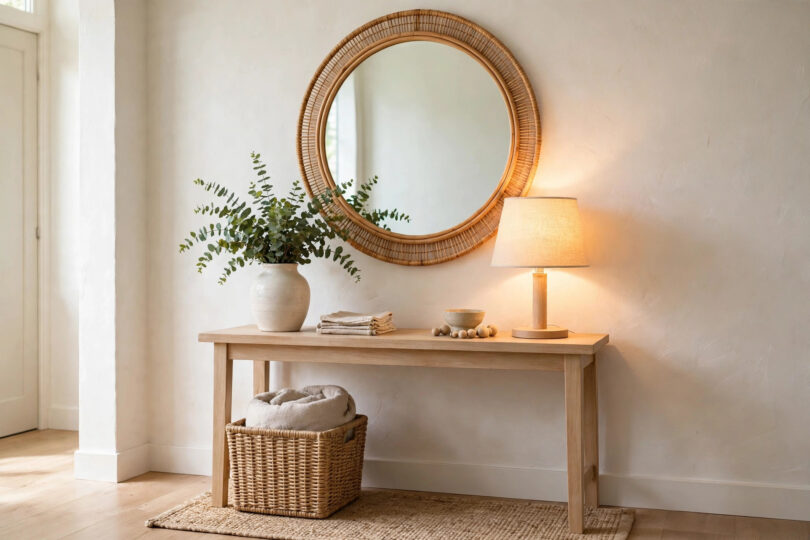

Your entryway is the first room anyone sees when they walk into your home, and it sets the tone for everything beyond the front door. Yet for most people it is also the most neglected space in the house, a dumping ground for shoes, keys and parcels. Good entryway decor ideas change that completely. With a few thoughtful choices, even a narrow hallway or a tiny landing can feel welcoming, organised and stylish. The best entryway decor ideas are not about spending a fortune or buying everything at once. They are about making the space work harder: a place for everything, a mirror to check yourself before leaving, light that flatters, and one or two personal touches that say something about the people who live there.
Start With What the Space Has to Do
Before you buy a single thing, watch how your entryway is actually used for a week. Where do shoes pile up? Where do keys land? Do bags get dropped by the door or carried further inside? Does the post get opened there or left on a table? Entryway decor ideas only work when they answer these real habits. A beautiful console table is useless if everyone still throws their coat over a chair, and a row of elegant hooks fails if it is placed where nobody naturally reaches. The most successful entryways are designed around behaviour first and looks second, and once the practical side is sorted, the style follows easily.
Measure the space honestly, including the swing of the front door and how much room you need to walk through comfortably. In a narrow hallway, shallow furniture is essential: a console no deeper than 25 to 30 centimetres, wall hooks instead of a coat stand, and a slim bench rather than a bulky cupboard. In a larger entrance hall, you can afford a proper storage bench, a tall plant and a statement mirror. Either way, leave a clear path of at least 80 centimetres so the space never feels like an obstacle course, no matter how much you add to it.
The Console Table: Your Entryway Anchor
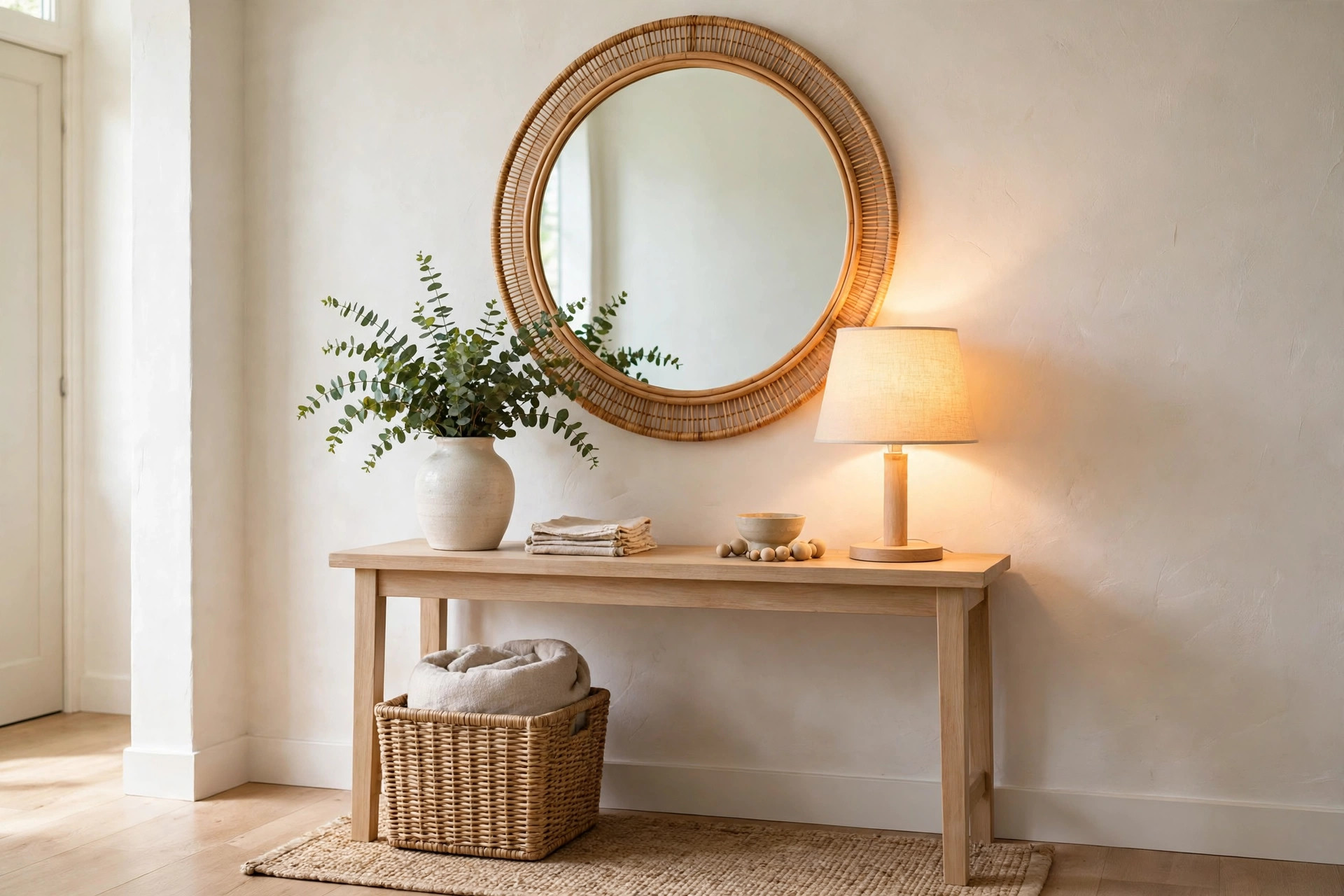
Almost every great entryway has one anchor piece, and most often it is a console table. It gives you a surface for keys, a bowl for loose change, a place for the post, and a display spot for a vase or a framed photo. Choose one that suits the scale of your space and the style of your home. A reclaimed wood console brings warmth to a modern flat, while a slim metal and glass design keeps a small hallway feeling light and open. If floor space is very tight, a wall-mounted shelf can do the same job without taking up a single centimetre of floor.
Style the console in layers rather than cluttering it. A tall item at one end, such as a vase with branches or a table lamp, a low stack of books or a decorative box in the middle, and a small tray to catch keys and sunglasses. The tray is the secret weapon of entryway decor ideas: it gives small essentials a home, so they stop migrating across every surface in the house. Empty the tray once a week and the whole entrance stays tidy with almost no effort.
Mirrors, Light and the Illusion of Space
A mirror is the hardest-working item in any entryway. It lets you check your appearance before heading out, it bounces light around a space that often has no window, and it makes a small hallway feel twice as big. Hang a mirror at eye level, large enough to be genuinely useful, and position it opposite or beside your light source so it reflects brightness into the room rather than a blank wall. A round mirror softens a hallway full of straight lines, while a tall arched mirror adds drama to a plain wall.
Lighting matters just as much. Many entryways rely on a single harsh ceiling light, which flatters nobody. Layer it instead: a pendant or flush-mount fitting for general light, a small table lamp on the console for warmth, and, if you have artwork or a feature wall, a picture light or a slim wall washer to draw the eye. Warm white bulbs, around 2700K, make the space feel inviting rather than clinical. If your entryway has no natural light at all, this layered approach transforms it from a dark corridor into a room you actually enjoy walking through, a principle that also runs through many luxury interior ideas where lighting is treated as decoration in its own right.
Storage That Hides the Mess
The difference between a stylish entryway and a chaotic one is almost always storage. Open baskets look charming in photographs but quickly become clutter magnets in real life. Closed storage keeps the visual calm: a bench with a lift-up seat for shoes, a cupboard with doors for coats, or lidded baskets on a shelf for scarves, gloves and dog leads. Give every regular item a designated spot and label it in your head, if not literally, so putting things away becomes automatic rather than a decision.
Shoe storage deserves special attention because shoes are the number one source of entryway mess. A two-tier shoe rack inside a bench, a pull-out drawer, or a simple tray with raised edges for wet days all work well. Keep only the shoes you wear daily by the door and store the rest elsewhere. The same rule applies to coats: the entryway should hold this season’s coats only, with out-of-season ones stored in a bedroom cupboard. Rotating seasonally takes ten minutes and keeps the space feeling generous all year.
Colour, Texture and Personality
Once the practical pieces are in place, the entryway is a wonderful place to be bold. Because it is a small space that people pass through rather than sit in, you can use a colour or pattern that might feel too much in a living room. A deep green or navy feature wall, a patterned runner, or a gallery wall of family photos all add character without overwhelming the home. If you prefer calm neutrals, add texture instead: a woven basket, a wooden bench, a wool runner and a ceramic vase give a neutral hallway depth and warmth.
A runner or rug is more than decoration in an entryway. It protects the floor from muddy shoes, defines the space, and adds softness underfoot. Choose a low-pile, washable rug in a pattern that hides dirt, and make sure it is long enough to feel intentional rather than like a doormat that lost its way. Layer a coir doormat outside the door and a softer rug inside, and you have a two-stage defence against dirt that keeps the rest of the house cleaner too.
Small Details That Make a Big Difference
Finally, it is the small details that turn a functional entryway into a welcoming one. A scented candle or a diffuser gives the first impression a pleasant smell, a small dish by the door holds keys without fail, and a hook at child height lets little ones hang their own coats, which means one less job for you. Fresh flowers or a branch from the garden, changed weekly, cost almost nothing and make the entrance feel alive. Even a single framed print that you love, hung where you see it every time you come home, changes how the whole house feels.
Seasonal touches keep the entryway feeling fresh without a full redecoration. A wreath on the door in winter, a bowl of lemons or a bright vase in summer, a change of cushion on the bench in autumn: these tiny rotations take minutes and stop the space from fading into the background. The most welcoming homes are not the ones with the most expensive furniture; they are the ones where the entrance says someone cares about the details. For more inspiration on making an entrance feel considered, explore the latest modern interior design trends and adapt the ideas that suit your space and budget.
Conclusion
Great entryway decor ideas are really about respect for the first few seconds of coming home. Plan around how you actually live, anchor the space with a console and a mirror, layer the lighting, hide the clutter in closed storage, and add personality with colour, texture and scent. Do those things and your entryway stops being a forgotten passage and becomes a proper room, one that welcomes you back every single day.